

“Do you think Tums would be OK?”
My wife, 26 weeks pregnant, was asking if I thought Tums would be OK for the cramping and stomach distress she was experiencing. I know, I know, why would we be thinking about anything but getting her to a hospital at that point? I guess we were in denial, because she kept insisting it was gas and I kept going with it. We had ruled out all the anti-gas products, most of the antacid products, and now were considering Tums.
“Well,” I answered, “It’s just calcium. Can’t see how it’d hurt…”
Only we didn’t have any. So off to the drugstore I went. Again, I know… what were we thinking? Truth is, I think we both knew something was dreadfully wrong and just couldn’t bear to admit it. I had been suggesting taking her to the hospital, then calling the ambulance, since the beginning of her complaints. Early on she felt an unusual pressure down there and asked me to look. What I saw was a bit of purple, veiny, membrane. We would find out later that I was looking at the amniotic sac. But still we couldn’t face what was happening.
This baby was everything to us. We had dreamed about him. The first time we saw him, he looked like a little peanut in her belly. I called him Peanut after that when I talked to him, which was often throughout the day. I wanted him to know my voice when he was born. He reacted to my voice every time I talked to him, once he had developed enough to. I could feel little appendages and later, hands reaching out toward me. We played music for him and I was delighted to find that he liked all the same music I did, including classic rock.
So we were in denial, and I was off to the drug store.
When I got back, I found my wife in our bathroom, hunched over in pain. I’ll never forget it. She looked up at me in total desperation and screamed a very primal scream.
“I’m calling the ambulance!!” I cried as I dropped the Tums and scurried off toward the phone. I didn’t hear any objection.
Everything seemed very chaotic from that point, but in retrospect, everything fell perfectly into place. The first EMTs were male and clearly out of their league. Then a second team showed up, one of whom was female and had experience delivering babies, including premature births. They asked what hospital our doctor worked out of and we told them. We would hear later that hospital had a reputation for not giving much attention to babies born as premature as ours, as they were considered to have very little chance of survival without serious complications.
Because the female EMT joined the first team, there wasn’t room in the ambulance for me and I was told to make my way to the hospital as quickly as I could. I was pulling out when the female EMT’s partner ran over to my car. He told me that they had decided at the last minute that they wanted to get her to the closest hospital. That hospital would turn out to be one of the top preemie hospitals in the country.
I drove like a madman to my new destination and while I did, my son was born in the ambulance. For place of birth, his birth certificate actually reads: En route to Winnie Palmer Hospital. Ever since, we’ve called him our en route baby. So he was born in the ambulance… still in the amniotic sac, breached, and at 26 weeks gestation. He kicked my wife all the way out, then his heart stopped.
When I ran into the emergency room I saw my wife on a table, screaming hysterically and reaching toward an adjacent table. She was alive.
On the table she was reaching for I saw what appeared to be a tiny… and lifeless… form. Around it was huddled at least eight or so medical personnel working frantically. After several moments of this activity, one of them broke away from the table and bounced over to me.
“Are you Dad?”
It would turn out that this would be my son’s doctor throughout his stay in the Neonatal Intensive Care Unit (NICU). Dr. McMahan was a very upbeat fellow and approached me with a huge smile, as though it was just another pretty day at the golf course.
“I don’t know, am I? Is my son alive?”
“Yes, of course!” Dr. McMahan laughed. I didn’t take his demeanor as cavalier. It exuded confidence in his ability to keep our son alive. In retrospect, I’m also sure that it was a face, in order to keep from panicking an already frightened parent.
That first day we were able to look at our son in his incubator and take a few pictures, but we weren’t able to touch him because preemies are very susceptible to over-stimulation.

On the second day of his life, I put my index finger in his incubator near his tiny hand. “Hello, son, I’m your father and I’m going to introduce you to this world.” He immediately reacted to my voice, reaching out to my finger and grasping it tightly. His strength surprised me. I could see struggle on his face as he tried, and finally succeeded in opening one of his eyes. He wanted to see the voice he had been hearing for so long. At that moment he captured all of my heart. I knew I would never, ever get it back… and I was okay with that.
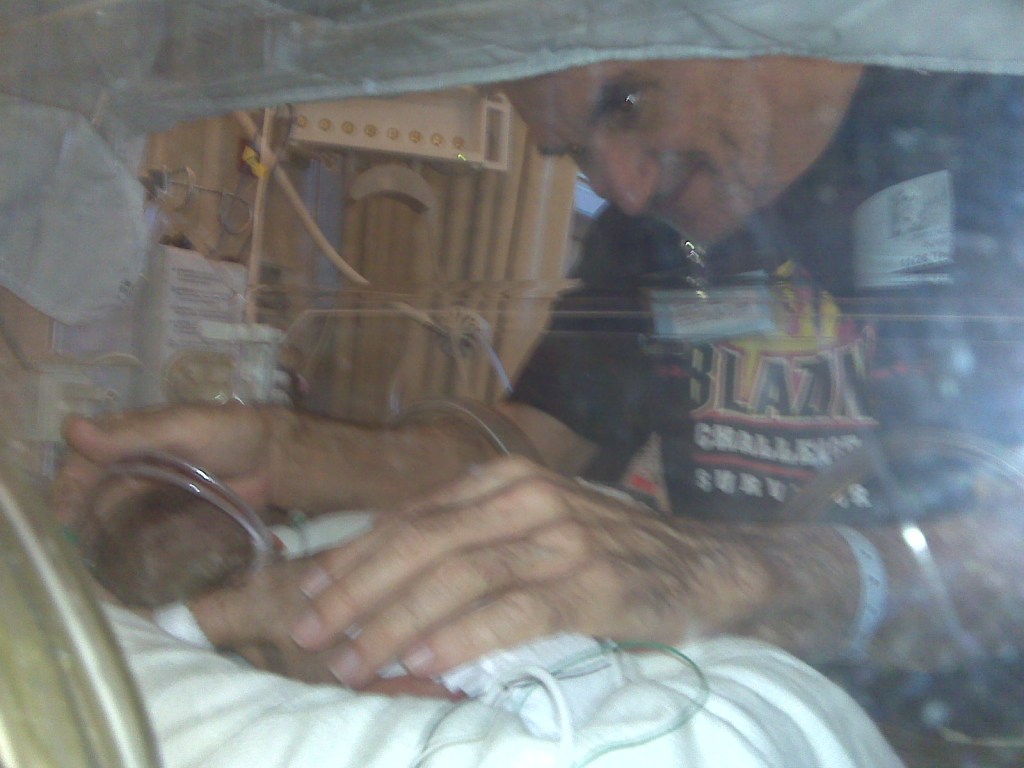
As that week progressed my wife and I learned about things like desats and bradys. Desat, short for oxygen desaturation, means that the baby’s blood oxygen level has fallen to dangerous levels. It usually happens because the baby has stopped breathing for more than 20 seconds. A brady, short for bradycardia, means that the baby’s heart rate has slowed dramatically. This usually happens in response to the desat. We would get a report in the morning of how many desats and bradys had occurred during the night. Sometimes the nurses would tell us that they had to “bag” him so many times. The first response to a desat and/or brady is to stimulate the chest area of the baby. If that doesn’t get the baby breathing again, they have to breathe for the baby with a bag apparatus. So when they told us this, they were effectively telling us that our baby had died or at least nearly died so many times during the night, but they were able to revive him.
My wife and I got quite good at reviving our baby when the alarms went off from a desat and/or brady. She could actually get him breathing again by calling his name. The nurses would often rush in to answer alarms, only to find that my wife and I had stopped the alarm by reviving our child. By the end of our NICU experience, we joked that we were practically medical personnel. Good thing since we had to do a lot of this on our own after taking him home.
During that first week we also met a young couple that had twins (a boy and girl) born at 24 weeks. Anything earlier than 24 weeks means that even if the child survives, chances are incredibly high that it will experience life altering and lifetime complications. Odds are not good in the 24 to 26 weeks range. We connected with the couple and chatted with each other as we crossed paths in the NICU.
About a month later we heard that their son had died during the night. We chatted after that, but there was distance. I think we were another painful reminder of their son’s death. For my wife and me, that was the first time that the reality of it all was shoved firmly into our faces. The stakes were high. The stakes were life and death.
We’ve been asked how we dealt with all of this and the answer, of course, is you just do. You suck it up, do your best not to think about the full reality much, and do what you have to do to help keep your child alive.
Here’s the thing: not everything about the NICU was a negative experience, far from. There were special opportunities for deep bonding afforded only to preemie babies and their parents. Hearing an alarm go off that indicates your baby has stopped breathing is a terrifying experience. Bringing your baby back to life rubbing his chest and calling to him is an incredible, heady, and deeply bonding experience.
The most joyous moments in the NICU, though, involved kangaroo care. The baby is stripped down to his diaper and the parent wears only a button down sweater or warm shirt. The baby is then held, skin to skin, against the chest.

I can’t begin to describe what an amazing experience this is: this tiny, frail person gently clasping his fingers at your chest. There is such a connection between parent and child that the parent’s body automatically regulates the baby’s body temperature, heart rate, blood pressure, and breathing. Dr. McMahan told us that between breastfeeding and kangaroo care we were upping our child’s chance of survival by fifty percent. It was a no-brainer that we would do these things.

Another kangaroo care session. Photo by Kimberly Olivier 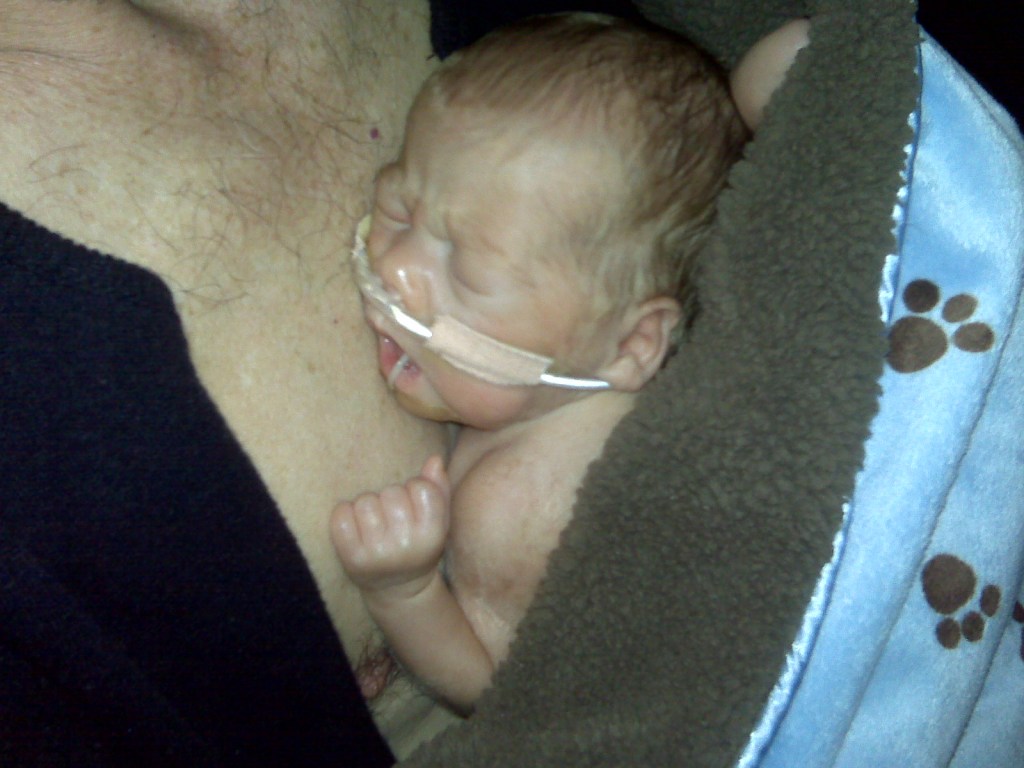
Tiny Fingers Grasping At My Chest. Photo by Kimberly Olivier
This was essentially our NICU experience of three months, two days (my wife knows the hours in addition): a roller coaster ride of terror and bonding joy. We’d learn (sometimes during the same day) about this new condition/complication and the resolution of that one. They sent him home with us on oxygen, a heart monitor, and strict orders to get him into his cardiologist because, oh yeah, the latest development was that he had dangerously high blood pressure.

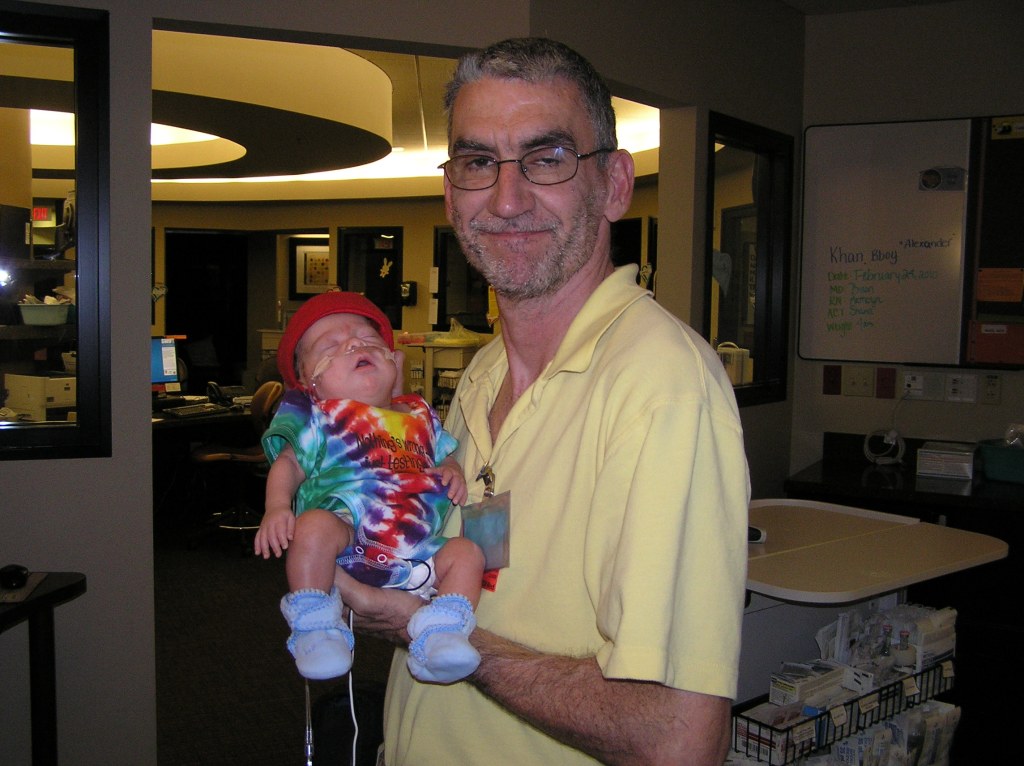
He had been out of the NICU one week when his cardiologist called after a recent appointment. Our son had congestive heart failure due to the high blood pressure. It was back into the hospital for two weeks and we added another specialist to the mix: a nephrologist. At this point he had: a cardiologist, pulmonologist, nephrologist, neurologist, and an ophthalmologist.
Those first two years were that same roller coaster ride we were so used to. It did slowly get better though. There were less new complications and more good news as we went. Major problems resolved and slowly specialists began to sign off on him. His cardiologist was one of the last around age two, certifying him with a healthy heart.
The three of us were in for his last checkup from his neurologist at age one. The doc gave him a clean bill of health. Then he proceeded to tell us everything that could have, and by all rights should have, happened: severe lung, heart, nervous system, and eye (pretty much all the major organs) complications; brain damage; death. After running through this laundry list of horrors he looked at us and said: “What you have here is a miracle child. There is no other way to put it.”
He’s four now and other than being a little small for his age (he’ll catch up on that one too), you’d never know he was a preemie. He’s a perfectly healthy, normal, and active four year old. It’s been a truly amazing journey so far. He still has my heart.

 Typed Words And Other Ramblings
What an amazing and heart-warming account. You are a remarkable family and your son is a beautiful miracle.
Thank you, Sandra. I’m glad you enjoyed the read.
So happy for you. 🙂 Beautiful story.
I love Corbin. Thank you for introducing me to him. Your story resonated, as we were NICU parents as well. Our children’s experiences were different, but in reading your earliest steps on the journey I know we share so many indelible memories. While other moms and dads of healthy newborns were enraptured with their babies’ facial expressions, we celebrated stable blood oxygen levels. While they cuddled their just-borns and counted toes, we donned masks and gowns and worked our fingers amongst wires and tubes to touch wrinkled skin. Your son is a beautiful boy, treasured and loved and celebrated. Cherish every moment !
Thank you so much! I wish the best for you and your family.